
Mini Disc Golf vs. Regular Disc Golf: What's Actually Different?
————————————————————————————————————————————————————————————————————————————————————————————————————
People who've never seen mini disc golf can usually guess what it is right away: disc golf, but smaller. That's largely correct, it's got the same basket-and-chains target. And the same goal of getting a disc from the tee spot to the pin in as few throws as possible. The word "miniature" sometimes makes me think that people will associate Mini with putt-putt. Back in 2004, the MDGF began creating its first rulebook, starting with the PDGA's rules. Parts that didn't translate to a smaller format were modified; some changes are straightforward, and others aren't as clear. The differences between traditional disc golf and its smaller counterpart will be looked at here.
————————————————————————————————————————————————————————————————————————————————————————————————————
The Discs Themselves
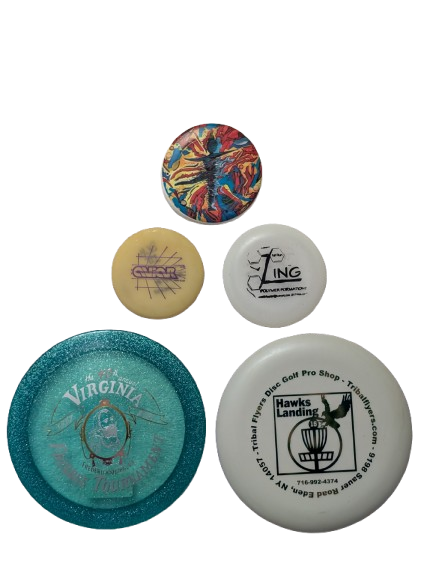
Minis of varying sizes with traditional driver and putter.
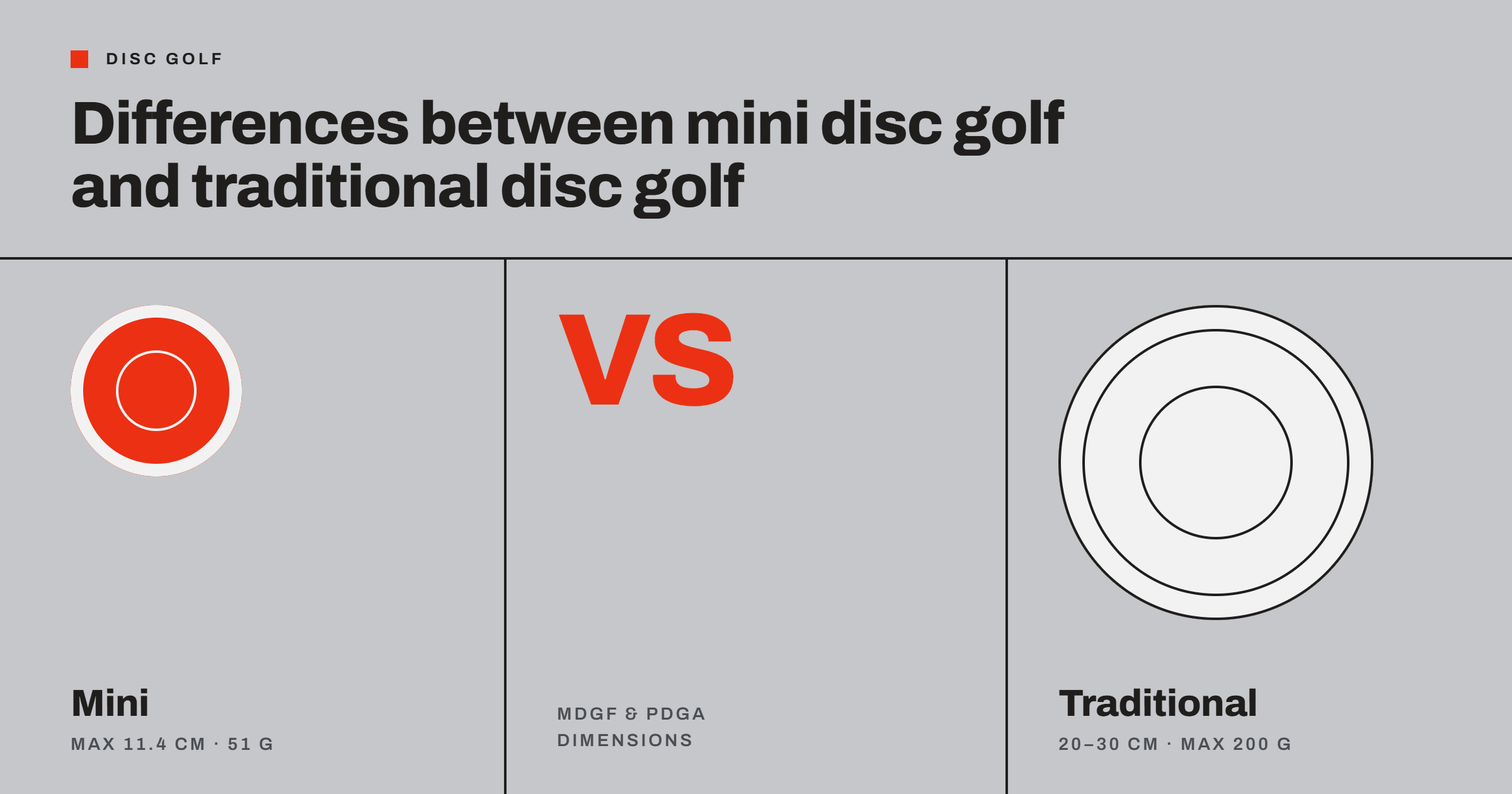
A regulation disc golf disc is built for distance and controlled flight over open terrain, which is evident in its size. They are well over 20 centimeters across and often weigh close to twice what a mini disc weighs.
MDGF's rulebook sets a limit for mini discs at 4.5 inches in diameter and 51 grams, making them comparable in size to a hockey puck. Plastic is the only option for materials, wood, epoxy, and metal aren't allowed, and this rule is driven by both durability and safety concerns.
Baskets are subject to similar regulations. To meet standards, a regulation basket must have a chain and pole that comply with specific requirements. In contrast, a mini basket only needs to be two feet off the ground, and this relatively low requirement is a major reason why mini courses can be set up in a variety of locations, as long as there are a few square feet available. This also allows course owners to get creative with their targets, creating unique mini-flavored works of art.
The World Flying Disc Federation (WFDF) references MDGF's size standard in its documentation. This makes it a key point of reference for other organizations as well. MDGF's size standard isn't internal, it's used by others.
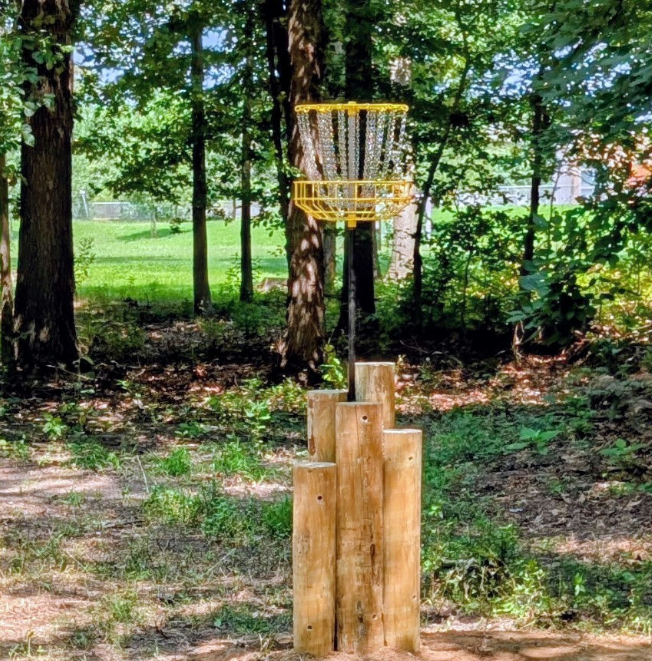
“Chesapeake” style mounting of an official MDGF Mini Target - Maryland
no run-up
MDGF differs from full-size play in several key ways, but one of the most notable is the restriction on throwing style. In regulation disc golf, it's common to see players use a running start to generate momentum for their drive, often taking a few strides or using an X-step to get a bit more distance out of their throw. In contrast, MDGF requires players to keep their lead foot planted firmly on the tee spot throughout the entire throwing motion, with no run-up or step-up allowed on any throw.
It's easy to overlook until you consider its purpose. What works on an open fairway, a three-step approach, often doesn't in the spaces where mini disc golf is typically played. By eliminating the run-up, the throw remains fair regardless of the course's size. Players are still allowed to follow through after releasing the disc, and they can jump or fall putts once they're within ten meters, the rule specifically targets the drive, not the entire throw.
Trees behave differently too
Mini disc golf differs from full-size disc golf in another key respect: it doesn't have a rule about discs stuck more than two meters off the ground.
In full-size disc golf, a disc wedged in a tree, for example, is generally considered out of bounds and rethrown.
Article VI of the MDGF rulebook explicitly states that the 2-meter rule doesn't apply to mini disc golf.
MDGF developed its own rules for suspended lies. A disc caught above something is spotted level with the lie when it's the player's turn, with no penalty, as long as it hasn't fallen. If it's beyond an out-of-bounds line, the disc incurs a one-stroke penalty and is dropped straight down to the playing position. Water out of bounds doesn't change how this works. A disc on top of the basket, partly caught in a tree, still counts as a putt, the federation won't take that away.
Boundaries are a local decision
Regulation courses have fixed boundaries that are published, so you know where out-of-bounds starts before throwing a disc. Mini disc golf also has boundaries, but they're set by the course owner or designer, not a universal standard. Boundaries for out-of-bounds and water hazards are decided by the person who built the course. If a disc goes out of bounds, it's usually played from where it lies. Flexibility is a big part of what makes mini courses so different from one to another; it allows a lot of differences.
What Hasn't Changed
That core of the game remains the same. Fewest total strokes wins, that's the basic rule. Scoring doesn't change, and a putt is considered good when the disc is supported by the basket. If a disc is lost during daylight play, there's a one-stroke penalty, and a marker is dropped where it was last seen. This penalty structure is standard in disc golf, and MDGF builds on it with an exception for glow rounds, where a glowing disc and a spotter affect the chances of finding a lost disc.
————————————————————————————————————————————————————————————————————————————————————————————————————
Frequently Asked Questions
Is mini disc golf just a smaller version of regular disc golf?
It's mostly yes, the same scoring and basic gameplay are used. However, MDGF introduced some rule changes for the smaller scale, such as banning run-ups and dropping the 2-meter rule, and it's up to the course designer to decide what's out of bounds.
Does the PDGA govern mini disc golf?
No, it doesn't. That rules for mini disc golf are set and maintained by the Mini Disc Golf Federation, which was founded in 2004. The Mini Disc Golf Federation's rules are based on the PDGA's rulebook, and the World Flying Disc Federation also references the Mini Disc Golf Federation's disc-size standard in its documentation, but the PDGA is not involved in governing the mini game.
Why doesn't mini disc golf use the 2-meter rule?
The 2-meter rule is meant for situations where discs get caught out of reach in tall trees on regular courses. Since mini disc golf is played differently and uses its own scale, MDGF introduced suspended-lie rules that fit how the game is actually played.
Can a regular disc golf marker disc be used for mini disc golf?
Yes, if it's made of plastic and meets the size and weight requirements, which are under 4.5 inches across and under 51 grams. This isn't surprising, given that mini disc golf originated from the marker discs that players typically carry in their bags, and many standard markers still fit the specifications.